

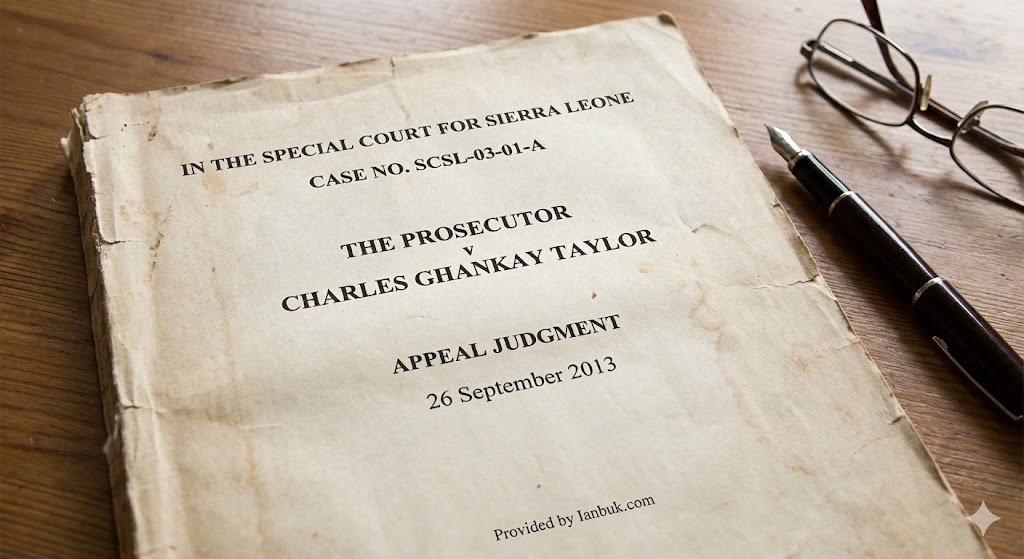
Jurisdiction: International criminal law, hybrid tribunal (Special Court for Sierra Leone)
Court: Special Court for Sierra Leone, Appeals Chamber
Coram: Hon. Justice George Gelaga King (Presiding), Hon. Justice Emmanuel Ayoola, Hon. Justice Renate Winter, Hon. Justice Jon Moadeh Kamanda, Hon. Justice Shireen Avis Fisher
Date of Judgment: 26 September 2013
Case Number: SCSL-03-01-A (appeal), arising from Trial Chamber II Case No. SCSL-2003-01-T
Legal Area(s): International Criminal Law, Crimes Against Humanity, War Crimes, Modes of Liability (planning, aiding and abetting), Sentencing
Tags: aiding and abetting, planning, substantial effect, knowledge, geographic scope of liability, sentencing, 50-year sentence
Legal Areas
International criminal law, appeal, crimes against humanity and war crimes, indictment covering multiple districts and time periods, modes of liability under Article 6(1), planning and aiding and abetting, elements of aiding and abetting (substantial effect and knowledge), sentencing and culpability of aiders and abettors, partial variation of liability findings for a specific district, sentence affirmed.
Procedural Posture
This was an Appeals Chamber judgment determining appeals from Trial Chamber II’s Judgment of 18 May 2012 (as revised by corrigendum of 30 May 2012) and the Sentencing Judgment of 30 May 2012, in which Charles Ghankay Taylor was convicted and sentenced to 50 years’ imprisonment.
Facts of the Case
The Special Court for Sierra Leone was established as a treaty based court between the United Nations and Sierra Leone, following UN Security Council action, with jurisdiction over serious violations of international humanitarian law and certain Sierra Leonean offences.
Taylor was charged in an 11 count indictment, alleging crimes against humanity and war crimes committed in Sierra Leone between 30 November 1996 and 18 January 2002, in specified districts (including Kailahun, Kenema, Bombali, Kono, Port Loko, and Western Area), involving acts such as terrorism, murder, rape, sexual slavery, outrages upon personal dignity, enslavement, pillage, and the conscription or enlistment of children under 15, among others.
The Trial Chamber convicted Taylor on all counts, finding criminal responsibility primarily through aiding and abetting, and for certain counts also through planning, and imposed a 50 year sentence.
Issues for Determination (as reflected in the Appeals Chamber’s treatment)
Modes of liability: whether the Trial Chamber committed reversible error in its findings on planning, including the geographic scope of planning liability for particular crimes.
Aiding and abetting doctrine: the correct articulation and application of the actus reus and mens rea for aiding and abetting under customary international law.
Sentencing: whether aiding and abetting, as a matter of law, generally warrants a lesser sentence than other forms of participation.
Remedies: what variations (if any) should be made to the Trial Judgment and sentence.
Decision / Judgment
Outcome: Appeals largely dismissed, with limited allowances and variations.
The Appeals Chamber allowed Ground 11 of Taylor’s appeal in part, and varied the Trial Judgment by excluding Kono District from the Trial Chamber’s findings that Taylor planned the crimes in Counts 1 to 8 and 11.
Prosecutor v Charles Ghankay Ta…
The Appeals Chamber allowed Prosecution Ground 4 in part, holding that aiding and abetting does not, as a general rule, warrant a lesser sentence, and varied the Trial Chamber’s reasoning accordingly, while affirming the 50-year sentence.
Legal Reasoning (Condensed)
(1) Aiding and abetting, elements affirmed
The Appeals Chamber reaffirmed aiding and abetting as a form of accomplice liability in customary international law, requiring practical assistance, encouragement, or moral support that has a substantial effect on the commission of the crime, and knowledge that the acts assist the crime’s commission.
(2) Planning liability, limited variation for Kono District
The Appeals Chamber addressed challenges to planning findings. While it upheld the convictions overall, it accepted a discrete point affecting the Trial Chamber’s planning findings for Kono District in relation to Counts 1 to 8 and 11, and removed that district from the planning findings (without setting aside the convictions as such).
(3) Sentencing, culpability of aiders and abettors
On the Prosecution’s appeal, the Appeals Chamber clarified that, in principle, aiding and abetting does not automatically justify a lower sentence. The sentence was not reduced and the 50-year term remained in force.
Key Quotations (Short Extracts)
On aiding and abetting: aiding and abetting is an accomplice liability mode, requiring assistance with “substantial effect” and knowledge.
Prosecutor v Charles Ghankay Ta…
On sentencing principle: aiding and abetting does not “as a general rule” warrant a lesser sentence.
Ratio Decidendi
Aiding and abetting, customary law test: liability requires conduct (assistance, encouragement, or moral support) that substantially affects the crime, plus knowledge that the assistance contributes to the crime.
Sentencing principle: aiding and abetting does not presumptively carry a lesser sentence compared to other participation forms, culpability depends on circumstances rather than labels.
Appellate remedial approach: where a specific legal or factual error affects part of a liability finding (here, planning in a particular district), the Appeals Chamber may vary that aspect without disturbing the overall convictions, where otherwise supported.
Obiter Dicta (Selected)
The judgment also addresses, for comparative clarity, other doctrinal frameworks such as joint criminal enterprise, stressing it is distinct from aiding and abetting, and that aiding and abetting concerns the accused’s contribution rather than co-perpetration through a shared common purpose.
Final Orders / Reliefs
Trial Judgment varied to exclude Kono District from findings that Taylor planned the crimes in Counts 1 to 8 and 11.
Prosecution Ground 4 allowed in part, Trial Chamber’s reasoning on sentence for aiding and abetting varied.
Sentence of 50 years’ imprisonment affirmed.
Prosecutor v Charles Ghankay Ta…
Prosecutor v Issa Hassan Sesay …
Commentary / Practice Note
This Appeal Judgment is a leading SCSL authority on (i) the customary international law elements of aiding and abetting (substantial effect plus knowledge), and (ii) sentencing parity, rejecting any rigid presumption that accomplice liability is inherently less blameworthy. It also illustrates a careful appellate remedy, correcting a specific overreach in planning findings (limited to a district) while preserving the overall integrity of the convictions.
Authorities Referred to in the Judgment (Compiled List)
A. Cases referred to (alphabetical, as extracted from the judgment)
A.M v. Italy; Al-Khawaja and Tahery v. UK; Al-Khawaja and Tahery v. United Kingdom; Bagosora and Nsengiyumva v. Prosecutor; Bissau v. Senegal; California v. Green; Crawford v. Washington; Davis v. Washington; Doe v. Unocal; Dutton v. Evans; Giles v. California; Gillick v. West Norfolk and Wisbech A.H.A; Khulumani v. Barclay Nat; Luca v. Italy; Lucà v. Italy; Michigan v. Bryant; Mohd Jamal v. Emperor; Netherlands v. Nuhanovic Supreme Court Judgment; Nsengiyumva v. Prosecutor; Ntawukulilyayo v. Prosecutor; Polyukhovich v. Commonwealth; Pretto v. Italy; Presbyterian Church of Sudan v. Talisman Energy; Prosecution v. Furundžija; Prosecutor v. Akayesu; Prosecutor v. Aleksovski; Prosecutor v. Ayyash et al; Prosecutor v. Bagaragaza; Prosecutor v. Bagilishema; Prosecutor v. Banović; Prosecutor v. Blaškić; Prosecutor v. Blagojević and Jokić; Prosecutor v. Boškoski and Tarčulovski; Prosecutor v. Bralo; Prosecutor v. Brima et al; Prosecutor v. Brđanin; Prosecutor v. Charles Ghankay Taylor; Prosecutor v. Delalić; Prosecutor v. Đorđević; Prosecutor v. Erdemović; Prosecutor v. Fofana and Kondewa; Prosecutor v. Furundžija; Prosecutor v. Gacumbitsi; Prosecutor v. Galić; Prosecutor v. Gotovina and Markač; Prosecutor v. Halilović; Prosecutor v. Haradinaj et al; Prosecutor v. Hatab; Prosecutor v. Jelisić; Prosecutor v. Kallon and Kamara; Prosecutor v. Kanyabashi; Prosecutor v. Kayishema and Ruzindana; Prosecutor v. Kordić and Čerkez; Prosecutor v. Kunarac et al; Prosecutor v. Kupreškić et al; Prosecutor v. Kvocka et al; Prosecutor v. Limaj et al; Prosecutor v. Milutinović et al; Prosecutor v. Nahimana et al; Prosecutor v. Naletilić and Martinović; Prosecutor v. Nchamihigo; Prosecutor v. Ntaganda; Prosecutor v. Ndindabahizi; Prosecutor v. Ntagerura et al; Prosecutor v. Orić; Prosecutor v. Perišić; Prosecutor v. Popović et al; Prosecutor v. Rutaganda; Prosecutor v. Ruzindana; Prosecutor v. Šainović et al; Prosecutor v. Semanza; Prosecutor v. Seromba; Prosecutor v. Sesay et al; Prosecutor v. Šešelj; Prosecutor v. Simić et al; Prosecutor v. Strugar; Prosecutor v. Štakić; Prosecutor v. Stanišić and Župljanin; Prosecutor v. Stanišić and Simatović; Prosecutor v. Stojiljković; Prosecutor v. Tadić; Prosecutor v. Taylor (trial references); Prosecutor v. Tolimir; Prosecutor v. Vasiljević; Prosecutor v. Vlastimir Đorđević; Prosecutor v. Vojislav Šešelj; Prosecutor v. Zigiranyirazo; R. v. Briscoe; R. v. Hibbert; R. v. Lam Kit; R. v. Leung Tak-yin; R. v. Clarkson; R. v. Woollin; Rukundo v. Prosecutor; Saïdi v. France; Unterpertinger v. Austria; US v. Greifelt et al; US v. Josef Alstötter and others; US v. Karl Brand et al; US v. Pohl and others; US v. van Leeb and others; US v. von Weizsaecker et al; Zigiranyirazo v. Prosecutor.
B. Statutes, rules, treaties, and other instruments referred to (as extracted)
Constitutive and procedural texts
Statute of the Special Court for Sierra Leone (including Articles: Article 2, 2(1), 2(3), 3, 4, 5, 6, 6(1), 6(2), 6(3), 7(1), 7(2), 8, 12, 12(1), 12(4), 13, 14(2), 15, 16(4), 17, 17(2), 17(3), 17(4), 18, 19, 19(1), 19(2), 20, 25(3), 29, 30, 30(1), 44, 60, 71, 74, 77(1), 78, 110, 121)
Rules of Procedure and Evidence (rules referenced include: Rule 14, 14(A), 16, 16(A), 16(B), 16bis(A), 16bis(B), 16bis(D), 29, 34, 39(ii), 54, 64, 72bis, 72bis(ii), 75(A), 78, 85(C), 87, 87(A), 88, 88(A), 88(C), 89, 89(A), 89(B), 89(C), 92bis, 92quater, 94, 94(A), 94(B), 95, 98bis, 100(A), 100(B), 101, 101(A), 101(B), 106, 108(A), 109, 111, 112, 113, 115, 119)
UN Security Council resolutions cited
UNSC Resolution 808 (1993); 1132 (1997); 1265 (1999); 1296 (2000); 1315 (2000); 1674 (2006); 1706 (2006); 1894 (2009); 1973 (2011); 1975 (2011)
International and comparative instruments referenced
Rome Statute of the International Criminal Court
Charter of the International Military Tribunal
Nuremberg Principles
Convention on the Prevention and Punishment of the Crime of Genocide
Convention against Torture and Other Cruel, Inhuman or Degrading Treatment or Punishment
Geneva Conventions, and Additional Protocol II
Statute of the International Criminal Tribunal for the former Yugoslavia
Statute of the International Criminal Tribunal for Rwanda
International Covenant on Civil and Political Rights