

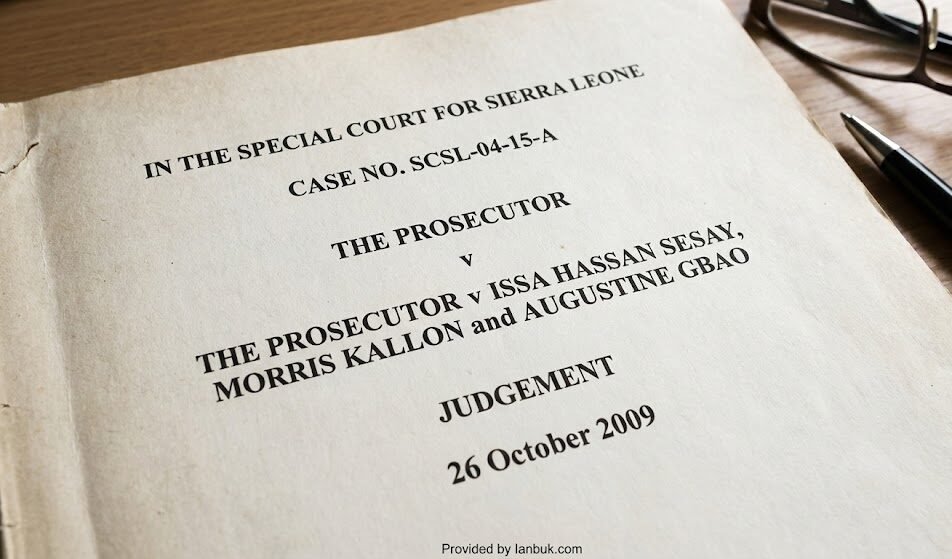
Jurisdiction: International criminal tribunal for Sierra Leone
Court: Special Court for Sierra Leone (SCSL), Trial Chamber I
Presiding Judge: Hon. Justice Pierre G. Boutet
Other Judges: Hon. Justice Benjamin Mutanga Itoe, Hon. Justice Bankole Thompson
Date of Judgment: Delivered 25 February 2009 (Freetown), filed 2 March 2009
Case Number: SCSL-04-15-T
Neutral Citation (as commonly reported): (SCSL-04-15-T) Trial Judgement, 2 March 2009 [2009] SCSL 1
Legal Areas: International Criminal Law, International Humanitarian Law, Crimes Against Humanity, War Crimes, Individual Criminal Responsibility (Article 6(1)), Command Responsibility (Article 6(3)), Joint Criminal Enterprise
Tags (research): RUF, AFRC/RUF Junta, armed conflict, terrorism (IHL), collective punishment, extermination, murder, rape, sexual slavery, forced marriage, outrages upon personal dignity, mutilation, pillage, child soldiers, attacks on peacekeepers (UNAMSIL), hostage taking, cumulative convictions
Appearances (Legal Representatives)
Prosecution
Dr. Ousman Njikam
Ms. Annika Jones
Ms. Brenda Hollis
Mr. Gerard Labudda
Defence
For Issa Hassan Sesay:
Mr. Joseph Fitzgerald
Mr. Franklin Rogers
For Morris Kallon:
Mr. Taylor N. Pearce
Mr. Tahir-Syed Atta Mohammed
For Augustine Gbao:
Mr. Vincent Thomas
Mr. Theophilus Gould
Office of the Principal Defender:
Mr. Vincent de Rooij
Legal Areas
International criminal tribunal, Sierra Leone armed conflict, responsibility of RUF senior leaders, joint criminal enterprise and superior responsibility, widespread attacks on civilians, sexual violence and enslavement, forced marriage as an other inhumane act, recruitment and use of child soldiers as customary international law offence, attacks against UN peacekeepers and humanitarian missions, elements of hostage taking under Common Article 3 and Additional Protocol II, and principles on cumulative convictions.
Background and Context
This Trial Judgement concerns three senior members of the Revolutionary United Front (RUF) during the Sierra Leone armed conflict, tried before the Special Court for Sierra Leone. The Prosecution alleged that the Accused participated in, planned, ordered, aided and abetted, or otherwise contributed to the perpetration of crimes committed by AFRC/RUF forces across multiple districts, including assaults on civilians, mass killings, sexual violence, enslavement, pillage, the use of children in hostilities, and attacks on UN peacekeepers.
The case is one of the principal SCSL Trial Chamber judgements elaborating: (i) the structure and scope of joint criminal enterprise liability in the SCSL context, (ii) the doctrinal recognition of “forced marriage” within the category of “other inhumane acts”, (iii) the criminalisation of child recruitment and use under customary international law prior to the indictment period, and (iv) the legal elements for attacks on peacekeepers and for hostage taking under Common Article 3 and Additional Protocol II.
Procedural History (abridged)
The Accused were charged on an indictment containing 18 counts.
The Trial Chamber heard extensive testimonial and documentary evidence relating to events spanning multiple districts and time periods, and received final submissions.
The Chamber issued its Trial Judgement, including majority findings and noted separate judicial opinions.
The Indictment (Counts)
War crimes and other serious violations of IHL (Statute, Articles 3 and 4):
Acts of terrorism (Article 3(d))
Collective punishments (Article 3(b))
Violence to life, health and physical or mental well-being (murder) (Article 3(a))
Outrages upon personal dignity (Article 3(e))
Violence to life etc (mutilation) (Article 3(a))
Conscripting or enlisting children under 15 or using them to participate actively in hostilities (Article 4(c))
Pillage (Article 3(f))
Intentionally directing attacks against personnel involved in a peacekeeping mission (Article 4(b))
Violence to life etc (murder of protected persons) (Article 3(a))
Taking of hostages (Article 3(c))
Crimes against humanity (Statute, Article 2):
3. Extermination (Article 2(b))
4. Murder (Article 2(a))
6. Rape (Article 2(g))
7. Sexual slavery (Article 2(g))
8. Other inhumane acts (forced marriage) (Article 2(i))
11. Other inhumane acts (physical violence) (Article 2(i))
13. Enslavement (Article 2(c))
16. Murder (peacekeeper victims, charged as CAH) (Article 2(a))
Issues for Determination (framed)
Applicable law and elements for each charged crime under the SCSL Statute, including the customary international law foundations for child soldier offences and the elements of hostage taking.
Modes of liability under Article 6(1), including personal commission, joint criminal enterprise, ordering, planning, instigating, and aiding and abetting.
Superior responsibility under Article 6(3), including the existence of superior-subordinate relationships, knowledge (actual or constructive), and failure to prevent or punish.
Evidentiary and contextual findings on whether the alleged crimes occurred in the charged districts and periods, and attribution to the Accused.
Cumulative convictions principles in relation to overlapping offences and overlapping modes of liability.
Holdings and Disposition
1) Issa Hassan Sesay
Convicted (GUILTY):
Count 1 (Acts of Terrorism)
Count 2 (Collective Punishments)
Count 3 (Extermination)
Count 4 (Murder, CAH)
Count 5 (Murder, war crime)
Count 6 (Rape, CAH)
Count 7 (Sexual Slavery, CAH)
Count 8 (Other inhumane acts, forced marriage, CAH)
Count 9 (Outrages upon personal dignity)
Count 10 (Mutilation)
Count 11 (Other inhumane acts, physical violence, CAH)
Count 12 (Child soldiers), convicted specifically of planning the use of children under 15 to participate actively in hostilities
Count 13 (Enslavement, CAH)
Count 14 (Pillage)
Count 15 (Attacks on peacekeepers)
Count 17 (Murder, war crime, relating to peacekeeper victims)
Acquitted (NOT GUILTY):
Count 16 (Murder, CAH, peacekeeper victims)
Count 18 (Taking of hostages)
2) Morris Kallon
Convicted (GUILTY):
Counts 1 to 11 (inclusive), namely terrorism, collective punishments, extermination, murder (CAH), murder (war crime), rape, sexual slavery, forced marriage, outrages upon personal dignity, mutilation, and other inhumane acts (physical violence)
Count 13 (Enslavement)
Count 14 (Pillage)
Count 15 (Attacks on peacekeepers)
Count 17 (Murder, war crime, relating to peacekeeper victims)
Acquitted (NOT GUILTY):
Count 12 (Child soldiers)
Count 16 (Murder, CAH, peacekeeper victims)
Count 18 (Taking of hostages)
3) Augustine Gbao
Convicted (GUILTY):
Counts 1 to 11 (inclusive), as charged, on the basis of participation in a joint criminal enterprise (with noted dissents on aspects)
Count 13 (Enslavement)
Count 14 (Pillage)
Count 15 (Attacks on peacekeepers), on the basis of aiding and abetting
Acquitted (NOT GUILTY):
Count 12 (Child soldiers)
Count 16 (Murder, CAH, peacekeeper victims)
Count 17 (Murder, war crime, relating to peacekeeper victims)
Count 18 (Taking of hostages)
Separate Opinions
Justice Boutet appended a partly dissenting opinion.
Justice Thompson appended a separate concurring opinion.
Key Legal Principles and Reasoning
A. Individual Criminal Responsibility under Article 6(1)
Joint criminal enterprise (JCE):
The Chamber treated JCE as a form of “commission” in which an accused, acting with others pursuant to a common purpose, bears criminal responsibility for crimes within that purpose, and in certain circumstances for other reasonably foreseeable crimes committed by members of the enterprise.
The judgement is notable for its careful mapping of alleged common purposes to temporal and geographic phases of the conflict, and for distinguishing (where possible) distinct conduct underpinning liability under Article 6(1) and Article 6(3).
Ordering, planning, instigating, aiding and abetting:
The Chamber evaluated whether the Accused’s conduct had a substantial effect on the commission of crimes and whether requisite mens rea was proved, including specific findings that some Accused were liable for planning, ordering or aiding and abetting in particular settings (notably UNAMSIL-related counts).
B. Superior Responsibility under Article 6(3)
Elements:
The judgement applied the classic three-part structure: (i) superior-subordinate relationship with effective control, (ii) knowledge or reason to know, and (iii) failure to take necessary and reasonable measures to prevent or punish.
Application:
The Chamber’s findings include convictions under Article 6(3) on certain counts where the conduct proved related to failures to prevent or punish, and where effective control was found.
C. Child Soldier Offence (Count 12)
Customary international law:
The Chamber accepted appellate jurisprudence that the offence of conscripting or enlisting children under 15, or using them to participate actively in hostilities, constituted a customary international law offence entailing individual criminal responsibility before the indictment period.
Meaning of enlistment and active participation:
The judgement adopted a functional approach to “enlistment” in the context of irregular armed groups, recognising that the concept extends beyond formal recruitment processes.
Outcome:
Sesay was convicted on a planning theory, whereas Kallon and Gbao were acquitted.
D. Hostage Taking (Count 18)
The Chamber emphasised that hostage taking requires proof of a threat against detainees used to obtain a concession or advantage, and found that this essential element was not proved beyond reasonable doubt, resulting in acquittals for all three Accused.
E. Attacks on Peacekeepers (Counts 15 to 18)
The Chamber applied the Statute’s protections for peacekeeping personnel, analysed knowledge and intent requirements, and differentiated liability by mode, including aiding and abetting for Gbao on Count 15.
F. Sexual Violence, Enslavement, and Forced Marriage
The judgement is a leading SCSL authority on sexual violence crimes, including sexual slavery and the conceptualisation of forced marriage as an “other inhumane act”, and on the relationship between rape, sexual slavery, and forced marriage for purposes of cumulative convictions.
G. Cumulative Convictions
The Chamber addressed when separate convictions may be entered for overlapping crimes and modes of liability, including when the underlying conduct is distinct.
Orders
The Trial Chamber entered convictions and acquittals as set out above.
Issues relating to sentence were addressed subsequently in separate proceedings.
Significance and Commentary
Doctrinal consolidation within SCSL:
The judgement consolidates the SCSL’s approach to JCE and superior responsibility in a factually dense conflict setting.
Forced marriage jurisprudence:
By treating forced marriage as an “other inhumane act”, the judgement contributes to the international criminal law taxonomy of gender-based crimes, and interacts with the SCSL’s broader jurisprudence on sexual violence.
Child soldier offence as customary law:
The judgement aligns the SCSL with international developments recognising child recruitment and use as criminal under customary international law, while still requiring precise proof of participation and mens rea by each accused.
Hostage taking boundary:
The acquittals on Count 18 underscore the requirement for a coercive nexus, namely a threat used to obtain a concession or advantage, preventing over-extension of hostage taking to all forms of unlawful detention.
Practical prosecution lessons:
The judgement illustrates the importance of district by district, time-sliced proof and attribution, and the need to link leadership conduct to operational crimes through credible evidence of command, control, contribution, and knowledge.
Cases and Laws Cited in the Judgment (Authorities)
Note: The judgement contains an extensive table of authorities, including SCSL, ICTY, ICTR, ICC, ICJ and other international decisions, together with treaty and customary law materials. The categories below follow the judgement’s own classification.
A. SCSL and other international criminal tribunal decisions (illustrative, not exhaustive)
Prosecutor v Brima, Kamara and Kanu (AFRC case), Trial Judgement and Appeal Judgement
Prosecutor v Fofana and Kondewa (CDF case), Trial Judgement and Appeal Judgement
Prosecutor v Norman (CDF proceedings), interlocutory decisions
Prosecutor v Tadić (ICTY), jurisdiction and JCE jurisprudence
Prosecutor v Krstić (ICTY), Trial and Appeal Judgements
Prosecutor v Kordić and Čerkez (ICTY), Trial and Appeal Judgements
Prosecutor v Blaškić (ICTY), Trial and Appeal Judgements
Prosecutor v Čelebići (Delalić et al) (ICTY), Trial and Appeal Judgements
Prosecutor v Akayesu (ICTR), Trial Judgement
Prosecutor v Kayishema and Ruzindana (ICTR), Trial and Appeal Judgements
Prosecutor v Thomas Lubanga Dyilo (ICC), confirmation and related decisions on child soldiers
B. International legal documents and treaties
Geneva Conventions, Common Article 3
Additional Protocol II to the Geneva Conventions
Charter of the United Nations (peacekeeping mission protections)
Rome Statute of the International Criminal Court (comparative materials)
C. Domestic and constitutive legal instruments
Statute of the Special Court for Sierra Leone
Rules of Procedure and Evidence of the Special Court for Sierra Leone
Related implementing or ratification instruments (as referenced in the judgement)
D. Secondary sources
Leading commentaries, treatises, and academic materials cited throughout the judgement on IHL and international criminal responsibility.
Recommended Citation
The Prosecutor v Issa Hassan Sesay, Morris Kallon and Augustine Gbao (SCSL-04-15-T), Trial Judgement, Trial Chamber I, Special Court for Sierra Leone, delivered 25 February 2009, filed 2 March 2009.